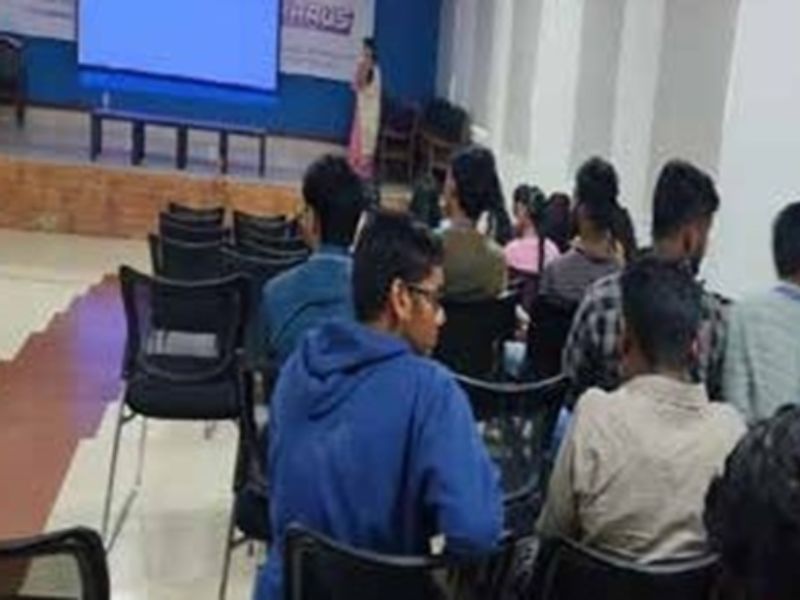
GuestLecture on “Introduction to Data Structure Session" was conductedby Mr. Adil, Founder & CEO of APTIVEX Solutions Pvt. Ltd. Organized
by Mrs. Manchala Manasa.
An Introduction to Data Structures:
At its core, a data structure is much more than a technical container; it is the fundamental blueprint that determines how a computer organizes, manages, and stores information for efficient access and modification. Imagine entering a massive warehouse where millions of items are scattered randomly on the floor; finding a single specific box would be nearly impossible. Data structures act as the shelving units, filing cabinets, and conveyor belts of that warehouse, transforming a chaotic pile of "bits" into a streamlined system. By choosing the right structure, a programmer can turn a search process that might take hours into one that takes microseconds. This organization is generally divided into two main categories: linear structures, where data elements are arranged in a sequence—like a line of people or a stack of trays—and non-linear structures, where data is connected in complex, hierarchical, or interconnected webs—much like a family tree or a map of city streets.
As we move toward more complex problems, non-linear structures like Trees and Graphs become essential for modeling the real world. A Tree structure mimics a natural hierarchy, starting from a single "root" and branching out into leaves; this is exactly how your computer organizes folders and files or how a website’s HTML is structured. The most famous variant, the Binary Search Tree, allows for incredibly fast searching by splitting the data in half with every step. Beyond hierarchies, Graphs represent networks where every point (node) can be connected to any other point. This is the sophisticated logic behind social media friend networks and GPS navigation systems, which calculate the shortest path between two cities. Ultimately, the study of data structures is not about memorizing code, but about understanding trade-offs—knowing when to prioritize memory savings over speed, and when to choose a complex structure to solve a complex human problem.