Mechanical EngineeringHighlights
- NBA Accredited under TIER II format up to 2027
- 14 Faculty, 4 Doctorates
- Leadership Positions – Dean R&D, Head Alumni, President IIC, CEO KASE
- 4 Faculty pursuing PhD, 1 PhD awarded
- 130+ Publications, Highest Impact Factor: 5, Highest h-Index: 09
- 10+ Student and 8 Faculty patents filed – 2 patents granted
- 30+ student research papers indexed in Scopus
- State-of-the-art research equipment
- Emerging Technology Clubs in 3D Printing and Electric Vehicles in association with SAEINDIA
- 100% of eligible students placed, with an overall average of 80%
AboutMechanical Engineering
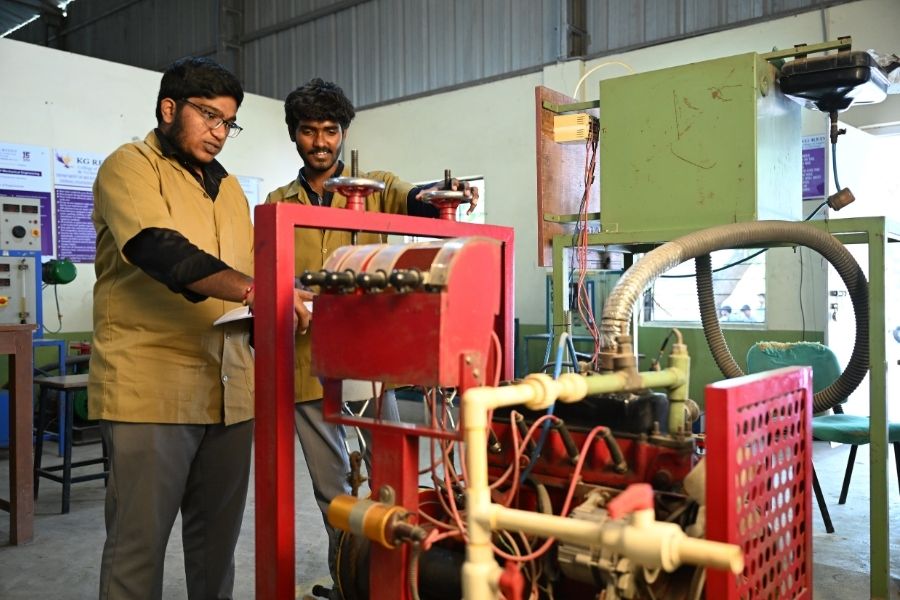
The Department of Mechanical Engineering at KG Reddy College of Engineering and Technology was established in 2009 and offers a four-year undergraduate program in Mechanical Engineering. Committed to academic excellence, the department implements innovative teaching-learning practices (TL-P) to ensure the effective delivery of Outcome-Based Education (OBE). This commitment has led to the department’s accreditation for three years (from 30-05- 2024 to 30-06-2027) under the TIER II format, applicable to students graduating between 2024 and 2027.
Mechanical Engineering is a highly versatile discipline that influences various aspects of daily life and industry. The department's strength lies in its dedicated faculty, skilled technical staff, and enthusiastic students. The Board of Studies continuously updates the curriculum to align with industry advancements and emerging technologies. The program equips future engineers with modern engineering tools and a strong foundation in the principles of force, motion, and energy, enabling them to develop innovative solutions to complex engineering challenges across diverse industries.
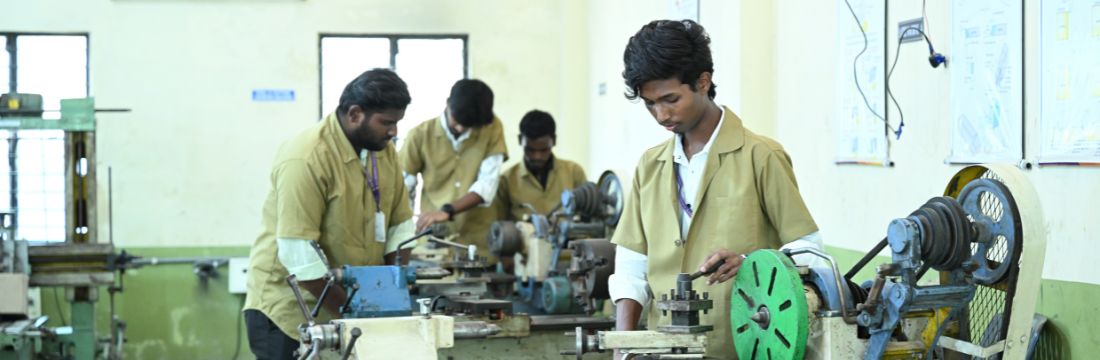
The Department is equipped with state-of-the-art laboratories that provide students with hands-on learning experiences. With funding support from DST, a dedicated research laboratory has been established, featuring advanced equipment such as a CNC Router, CNC Fiber Laser Cutting Machine, 1500W 3-in-1 Fiber Laser Welding Machine, and an NC Sheet Metal Bending Machine, Co2 Laser cut CNC Machine, Milling machine. From the first year onward, the curriculum emphasizes both conventional drawing techniques and computer-aided engineering graphics, fostering strong design skills. The department houses 14 well-equipped laboratories along with an Emerging Technology Club, specializing in 3D printing. Through certification courses, students receive training in various modeling and analysis software, enabling them to undertake mini and major projects using in-house laboratory facilities.The Emerging Technology Club actively encourages student participation in interinstitute competitions, leading to significant achievements at state and national levels, further strengthening their technical expertise and innovation skills.
The department maintains strong industry partnerships, ensuring alignment with evolving industry needs through active contributions to curriculum design, industrial visits, expert lectures, and workshops. These collaborations enable students to gain practical exposure and hands-on experience in their respective fields. We have established partnerships with leading organizations such as Automated Tooling Systems Pvt. Ltd, Government Technical Tool Room (Karnataka), Design Labs, H-Bots Robotics, ESCI, IIIT Hyderabad, GRIET, Samskriti Foundation, and BVIC – NGO, among others. These collaborations provide students with valuable internship opportunities in manufacturing, design, and thermal specializations. Additionally, industry visits allow students to engage with real-world challenges, fostering innovation and problem-solving skills. Furthermore, our partnerships with NGOs enable students to contribute to social issues, promoting sustainable development. As a result of these initiatives, 24 students from the 2021-25 graduating batch have secured stipend-based internships, with compensation ranging from ₹7,000 to ₹15,000, reinforcing the department’s commitment to industry-oriented learning and professional growth.
The department, in collaboration with the institute, has established a transparent appraisal system aimed at fostering both institutional and faculty development. This system emphasizes key areas such as academics, research, professional growth, and service to the institution. Faculty members are encouraged to set personal and professional goals, with dedicated research hours provided each week to support their scholarly pursuits. To further incentivize excellence, faculty members receive performance-based increments for achievements such as publishing research papers, filing patents, and contributing to book chapters. As a result of this structured approach, the department has successfully produced 14 SCI-indexed papers, 78 Scopus-indexed conference papers, and filed 5 patents, with 2 already granted. Additionally, undergraduate student projects have led to 18 publications and 3 published patents, showcasing the department's commitment to academic and research excellence.

Vision
To be recognized as a department, providing quality technical education and producing highly competent and skilled engineers to suit the latest trends in modern industry and to act as a catalyst for sustainable development.

Mission
- To impart quality education to the students and enhance their skills by integrating strong fundamentals, practical skills through Curriculum, and industry interaction, enabling graduates to contribute effectively to engineering practice.
- To integrate innovative teaching and learning practices that enables students to build strong technical competence in mechanical Engineering
- To foster a collaborative environment that encourages innovation, research and Entrepreneurship among faculty and students, contributing to sustainable development.