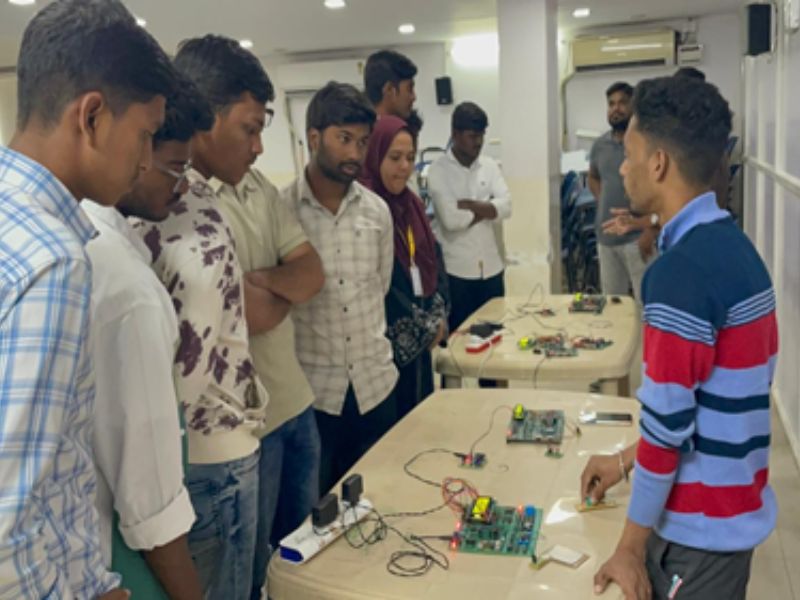
While the theoretical foundations of computer science and electrical engineering provide the "why," practical laboratory sessions are where students discover the "how." Transitioning from a sanitized, virtual IDE to a breadboard teeming with jumper wires and integrated circuits represents a significant shift in a learner's cognitive development. In this physical environment, code is no longer just an abstract sequence of logic; it becomes a series of electrical impulses—high and low voltage states—that must interact precisely with the physical properties of transistors, capacitors, and resistors.
This transition introduces students to the gritty reality of hardware debugging, a discipline far removed from simply checking for syntax errors. In a lab setting, a program might fail not because of a logical flaw, but because of "noise" in a signal, a loose ground wire, or the thermal limitations of a component. By engaging directly with sensor modules—such as accelerometers, ultrasonic transducers, or infrared receivers—students learn to navigate the complexities of the physical world, including signal attenuation and environmental interference. They begin to appreciate the necessity of low-level drivers and the intricacies of communication protocols like $I^2C$, $SPI$, and $UART$.
Furthermore, these sessions foster a unique form of technical agility. When a system fails in a laboratory, the solution often requires a holistic approach that bridges the gap between domains. A student might need to use an oscilloscope to visualize a pulse-width modulation ($PWM$) signal to understand why a motor isn't spinning at the commanded speed, effectively diagnosing a software timing issue through physical observation. This cross-disciplinary troubleshooting is essential for designing modern integrated systems, such as robotics or IoT devices, where the software and hardware are inextricably linked.
Ultimately, the collaborative nature of the lab environment mirrors professional engineering settings. Students must communicate technical hurdles, share diagnostic tools, and iterate on designs in real-time. This hands-on experience demystifies the "black box" of technology, transforming students from mere consumers of high-level languages into architects who understand the fundamental physics that power their code.