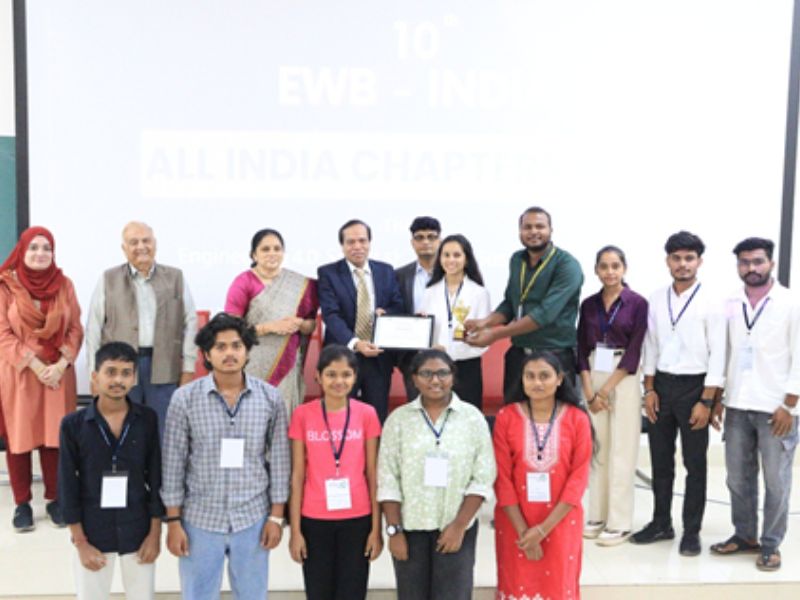
The participation of our department's team in the Engineers Without Borders (EWB-India) All India Chapter event, hosted at the Marri Laxman Reddy Institute of Technology (MLRIT), represented a significant milestone in our commitment to holistic engineering education. This national-level gathering was not merely a conference; it was a vibrant ecosystem of innovation where students and seasoned professionals from prestigious institutions across India converged to exchange ideas. By stepping outside the traditional classroom environment, our students were immersed in an atmosphere of collaborative engineering, where the focus shifted from theoretical calculations to the practical, human-centric application of technology. The event served as a rigorous training ground for the next generation of engineers, emphasizing that the true value of technical skill lies in its ability to solve pressing societal issues.
Throughout the duration of the event, our team engaged in high-level dialogues and workshops that highlighted the intersection of leadership and social responsibility. Engaging with diverse perspectives from across the country allowed our students to witness firsthand how engineering can be a tool for empowerment in underserved communities. This exposure is invaluable, as it bridges the gap between academic knowledge and real-world implementation. The discussions on sustainable infrastructure, rural development, and eco-friendly technologies challenged our team to think critically about the environmental and social footprints of their future professional work. Such interactions are crucial for developing "global engineers" who are not only technically proficient but also socially conscious.
Furthermore, the event acted as a powerful catalyst for professional networking and teamwork. Navigating the complexities of the EWB-India challenges required our team to function as a cohesive unit, delegating tasks effectively and supporting one another under tight deadlines. These soft skills—communication, adaptability, and collective problem-solving—are the hallmarks of successful professionals in the modern industry. By building bridges with peers and mentors from various regions, our students have expanded their professional horizons, creating a network that will support their careers long after graduation. Ultimately, this participation has reinforced a culture of purpose-driven innovation within our department, motivating students to apply their engineering expertise to create tangible, positive changes in the world around them.